Lore Lassen

Fiction

Works

Literary fiction and mysteries about memory, identity, place, and the distance between what happened and what is remembered.

Cover of A Woman of Some Renown by Lore Lassen: a creased vintage photograph of an unknown woman on black

No. 01

A Woman of Some Renown

Death made some body of her.

She was nobody while she was alive. Then someone murdered her. Now her face is everywhere.

She was nobody while she was alive.

Then someone murdered her.

Now her face is everywhere.

Newspapers print her photograph. Television programs reconstruct her final hours. Amateur investigators retrace her last known movements, and strangers argue over where she came from, what kind of woman she was, and why someone wanted her dead.

They give her histories, motives, relationships, secrets, and eventually a story.

They still cannot give her a name.

Because even in death, no one knows who she is.

There is only one person who does.

Her.

As she slowly realizes that she is dead, she watches an unidentified body become one of the most famous women in the country. Police, journalists, investigators, witnesses, and strangers each construct a different version of the woman they believe she must have been.

The more renowned she becomes, the less any of them seem to know her.

Finding her killer may explain how she died.

It cannot tell the living who she was.

Purchase links to follow

Cover of Monster Revision by Lore Lassen: a woman at a candlelit desk lowering a pale mask from her face

No. 02

Monster Revision

She made him up. Everyone else made him real.

Emily Evans wrote the books. George Ellis got the credit. Then the books became successful.

Emily Evans wrote the books.

George Ellis got the credit.

He was supposed to be nothing more than a name on a cover: a male pen name behind which Emily could publish without giving the world herself.

Then the books became successful.

And George became something Emily never intended him to be.

Famous.

Readers want interviews. Critics analyze his work. Publishers know what a George Ellis novel should sound like. Fans know what he believes, what he fears, and what he will write next.

Eventually Emily decides she has had enough.

She tells the truth.

George Ellis does not exist.

She is George Ellis.

No one believes her.

And when new writing begins appearing under George's name, Emily is forced to consider a considerably worse possibility.

Maybe the man she invented no longer needs her.

Purchase links to follow

Cover of Order of Opposites by Lore Lassen: a grid of aged photographs surrounding the title

No. 03

Order of Opposites

The opposite can also be true.

After a woman's death, a box arrives containing the ordinary debris of a life. The dead woman has her face.

After a woman's death, a box arrives containing the ordinary debris of a life: photographs, letters, recordings, receipts, ticket stubs, newspaper clippings, and other pieces of evidence.

The dead woman has her face.

She has a twin sister.

She never knew she had one.

The box appears to offer an explanation for the stranger who looks exactly like her.

Instead, it offers several.

Put the pieces in chronological order and they tell a story of suicide.

Follow the sequence hidden among them and they describe a murder.

Reverse the order and they suggest something impossible.

Her sister may still be alive.

Every photograph is real. Every letter is genuine. Every piece of evidence can be verified.

Nothing changes except the order in which she encounters it.

And every order appears to tell the truth.

Until it doesn't.

Purchase links to follow

Cover of Permanent in Pencil by Lore Lassen: a portrait half drawn in pencil, half erased, on aged paper

No. 04

Permanent in Pencil

The correction may outlast the original.

Her grandmother left behind a lifetime in ink. Someone else left corrections in pencil.

Her grandmother left behind a lifetime in ink.

Someone else left corrections in pencil.

At first, the faint annotations scattered through decades of journals seem ordinary enough: disagreements, additions, reminders of details the writer apparently forgot.

Then one note describes something that happened years after the entry beside it was written.

Another describes something that hasn't happened yet.

When the same unfamiliar handwriting begins appearing in her own notebooks, she does what anyone would do.

She tests it.

The pencil is right.

Again and again.

But accepting a correction has a cost.

Each time she changes her account to match what the pencil says, something from her original version disappears.

Soon the question isn't who is writing in the margins.

It's how much of her own story will remain when they're finished.

Purchase links to follow

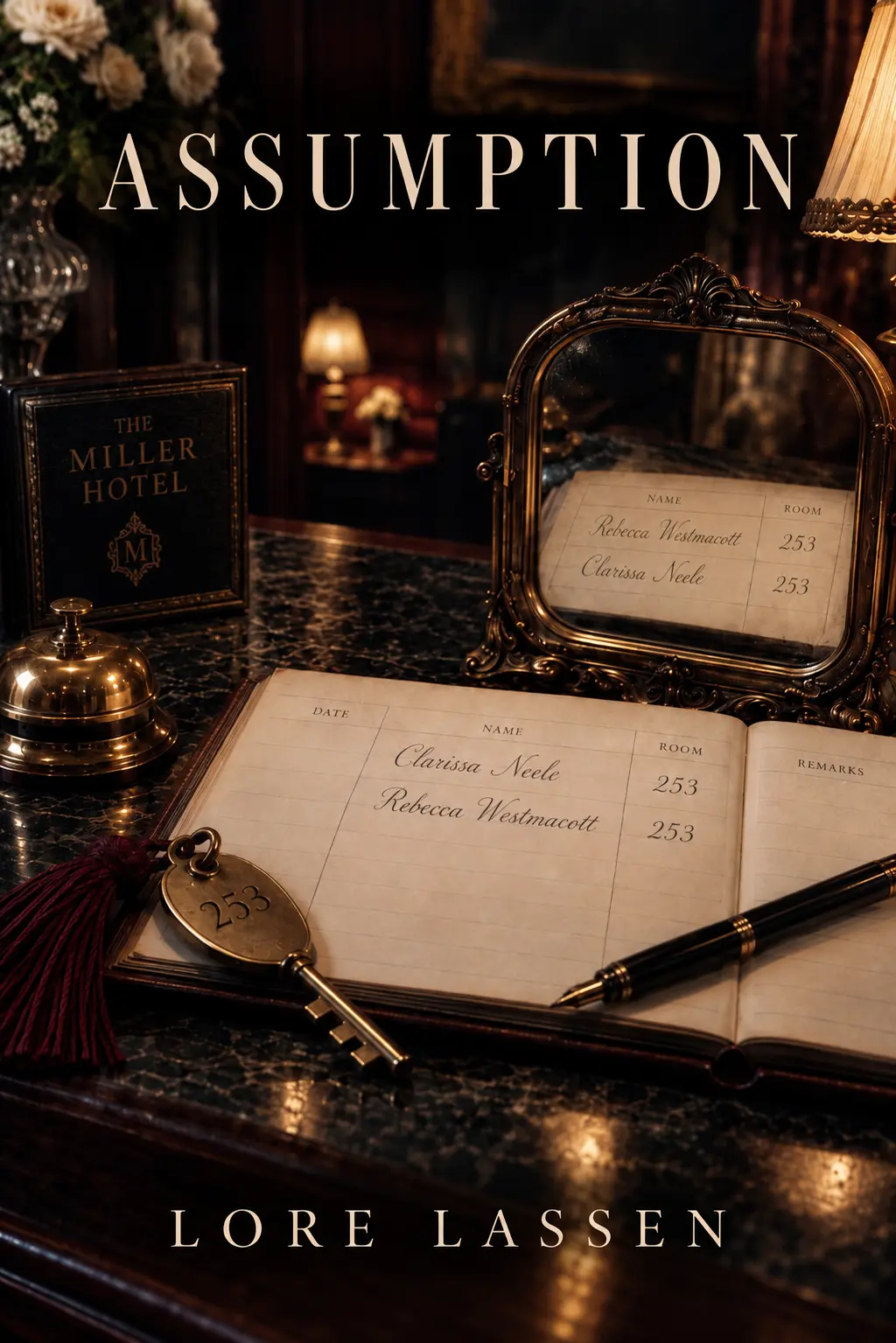
Cover of Assumption by Lore Lassen: a hotel register, brass key and mirror on a lamplit reception desk

No. 05

Assumption

Assume nothing. Especially your name.

She checks into the Miller Hotel under her own name. At least, she believes she does.

She checks into the Miller Hotel under her own name.

At least, she believes she does.

The staff recognizes her. Her room is ready. Her belongings are already inside.

There is just one problem.

They are calling her by another woman's name.

The hotel register places two women in Room 253.

Records exist for both.

People remember both.

Each woman appears to have occupied the same room, signed the same documents, and lived pieces of the other's life.

Then the hotel register and its reflection stop agreeing.

The deeper she searches for proof of which identity belongs to her, the more evidence she finds for the other.

Someone has assumed another woman's identity.

She just doesn't know which one of them did it.

Purchase links to follow